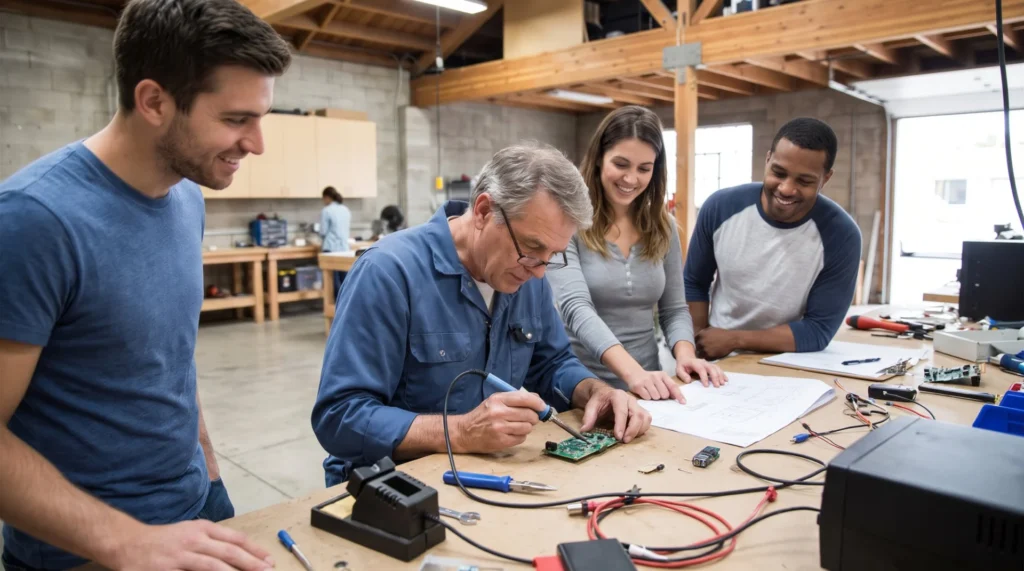

An apprenticeship trainer — often titled trainer-coach — teaches the skills an apprentice needs and coaches them through their apprenticeship standard from start to finish. In practice the role means delivering training, managing a caseload of apprentices, running the off-the-job training the programme requires, and holding regular progress reviews with both the apprentice and their employer — all while keeping to the funding and evidence rules the apprenticeship runs on. The trainer's job is to get each apprentice occupationally competent and ready for gateway, at which point an independent organisation carries out the final end-point assessment (EPA). Most trainer-coaches come in on occupational expertise and add a teaching qualification such as the Level 3 Award in Education and Training, and often an assessor qualification, on the job. Pay is indicatively £28,000 to £47,000 (National Careers Service, 2026). Here is the role in full — what it involves, what good looks like, what it pays, and the route in.
Figures here are indicative and dated. The salary band is the National Careers Service "further education teacher" profile (accessed July 2026), which covers the Learning and Skills Teacher route into apprenticeship training. Actual pay varies by subject, sector, employer and region — treat it as a guide, not a fixed rate.
What does an apprenticeship trainer do day-to-day?
Most of the week is spent with apprentices rather than in front of a full class. A trainer-coach delivers the training an apprenticeship standard requires, then coaches a caseload of apprentices through it — visiting them in the workplace or teaching in a training centre, setting and marking work, and building the evidence that shows each one is progressing. The relationship is closer to one-to-many coaching than to lecturing a cohort: you carry a personal caseload, and each apprentice is at a different stage.
A large part of the role is off-the-job training — the structured learning that happens away from an apprentice's normal duties and is a funding requirement of every apprenticeship. The trainer plans it, delivers or arranges it, and records it, because a provider has to be able to evidence that off-the-job training genuinely took place. Alongside that sits a steady rhythm of progress reviews: regular tripartite meetings involving the apprentice, the trainer and the employer, where you check progress against the standard, agree the next targets, and flag anything slipping early enough to fix it.
The part that surprises people moving in from industry is how much of the job is administrative discipline. Apprenticeships are funded provision, so accurate records, on-time reviews and defensible evidence are what protects the funding and stands up to audit and inspection — a trainer who can coach brilliantly but can't keep clean records is only half the hire.
How does an apprenticeship trainer prepare apprentices for gateway and EPA?
The whole programme builds towards one checkpoint: gateway. The trainer's job is to get each apprentice occupationally competent and ready — with the knowledge, skills and behaviours in the standard, any mandatory qualifications, the minimum duration served, and the required English and maths in place. At gateway, the employer and training provider confirm the apprentice is ready to be assessed, and the employer has the final say on whether to put them forward (gov.uk, 2026). Getting a caseload gateway-ready, on time and together, is one of the genuine skills of the role.
What happens next is deliberately out of the trainer's hands. Once an apprentice passes gateway, the end-point assessment (EPA) is carried out by an independent End-Point Assessment Organisation (EPAO) — separate from both the employer and the provider — whose independent assessor judges occupational competence against the standard's assessment plan (apprenticeships.gov.uk, 2026). The trainer prepares the apprentice for that assessment but does not conduct it, which is the point of the model. If you want the detail of how that final stage works, our explainer on end-point assessment and the gateway walks through gateway, the EPAO and the independent assessor.
If you already work in an industry and are weighing a move into training apprentices, this is the shape of the job — coaching people towards a standard you have met yourself. A specialist recruiter can tell you which providers are hiring for your occupation and what they will expect.
What qualifications and experience does an apprenticeship trainer need?
The route in is shorter than most people expect, because it builds on experience you already have. There is no statutory requirement to hold a teaching qualification before you start — the mandate for FE was revoked in 2013 — but colleges and training providers expect a recognised qualification, or a clear willingness to gain one on the job. In practice most trainer-coaches enter on occupational expertise and qualify while employed. The table below sets out what a provider typically looks for.
| What a trainer needs | Typical qualification or evidence | Why it matters |
|---|---|---|
| Occupational competence in the subject | Recent, credible industry experience, usually a Level 3+ qualification in the field | You coach apprentices to a standard you have met yourself; currency is what employers weigh most |
| A teaching or training qualification | Level 3 Award in Education and Training (AET) to start; often the Learning and Skills Teacher Level 5 apprenticeship or the Level 5 Diploma in Teaching (FE and Skills) | Shows you can deliver and coach, not just do the job |
| An assessor qualification (often) | Level 3 Certificate in Assessing Vocational Achievement (CAVA) | Many trainer-coach roles also assess, so a dual-qualified trainer is easier to deploy |
| English and maths | Level 2 English and maths | Expected across FE and skills delivery roles, and needed to support apprentices with their own |
Two of those rows are worth a note. Many providers fund the teaching qualification on the job, and the Learning and Skills Teacher Level 5 apprenticeship is a common way for a working trainer to gain it. And because so many trainer-coach posts blend delivery with assessment, an assessor qualification is a strong second string — if that side interests you, our guide on how to become an assessor in FE covers CAVA and the narrower standalone awards.

What does "good" look like in an apprenticeship trainer?
A course page tells you the qualification; it won't tell you what separates a strong trainer-coach from an average one. In our day-to-day work recruiting across the sector, the first thing providers weigh is occupational currency — how recent and credible your own experience in the subject is. An apprentice can tell in minutes whether the person coaching them still knows the job, and a trainer who left the trade last year is a far more convincing hire than one who left a decade ago.
Beyond currency, the trainer-coaches who stand out share a few habits. They manage a caseload without letting anyone drift — they know which apprentices are ahead, which are at risk, and what each one needs before the next review. They run the tripartite relationship well, keeping employers genuinely engaged rather than treating reviews as form-filling. They keep clean, timely records, because off-the-job evidence and progress reviews are what funding and inspection hang on. And the ones easiest of all to place are dual-qualified — able to both train and assess — because that flexibility is exactly what a provider juggling delivery and capacity needs.
If you are a college or training provider trying to fill a trainer or trainer-coach vacancy in a shortage occupation before your delivery year starts — and finding the shortlist thin — that is precisely the brief we recruit for.
What does an apprenticeship trainer earn — and how strong is demand?
The National Careers Service puts the further education teacher band, which covers the Learning and Skills Teacher route into apprenticeship training, at £28,000 for a starter to £47,000 for an experienced practitioner (2026). That is the public guide; where an individual lands within it has less to do with years served than with subject, sector and scarcity, and training-provider titles such as skills coach, development coach or trainer-assessor can pay to their own scales.
Demand is real and uneven, and the reformed Growth and Skills Levy is part of the reason. Foundation apprenticeships have been available since August 2025 and the minimum apprenticeship duration is now eight months (as of 2026) — changes that broaden the range of provision a provider delivers and keep pressure on the trainer-coach workforce that delivers it. We look at what that means for staffing in our piece on what the Growth and Skills Levy reforms mean for staffing delivery. The trainers who command the top of the band, and beyond it, are consistently those in occupations where industry outpays education — construction, engineering, digital, health and social care — especially when they are also assessor-qualified.
How Aptitude can help
We recruit only across the further education, skills, apprenticeships and employability sectors — our founders came from delivery roles in it — so we know the difference between a trainer-coach, an assessor and an EPA independent assessor, why occupational currency counts for so much, and which occupations are genuinely hard to staff right now. If you are moving into training from industry, or you already deliver apprenticeships and want the right post rather than the first one advertised, we can point you at roles that fit and tell you honestly where your experience will command a premium. See our advice for candidates and the sectors we cover, and talk to us before you settle for the nearest vacancy.
Frequently asked questions
What is the difference between an apprenticeship trainer and a trainer-coach? They are usually the same role under different labels. "Apprenticeship trainer," "trainer-coach," "skills coach" and "development coach" all describe someone who delivers training and coaches a caseload of apprentices through their standard. Titles vary by provider, but the core job — deliver, coach, review, prepare for gateway — is consistent.
Do apprenticeship trainers do the end-point assessment? No. A trainer prepares the apprentice up to gateway, but the end-point assessment is carried out by an independent End-Point Assessment Organisation whose assessor had no part in the training. That independence is deliberate. Some individuals hold both a trainer role and, separately, work as an independent assessor for an EPAO — but not on the same apprentices.
What qualifications do you need to become an apprenticeship trainer? You need occupational competence in your subject — genuine, recent experience, usually backed by a Level 3 or higher qualification — plus a teaching or training qualification such as the Level 3 Award in Education and Training, often gained on the job. Many trainer-coach roles also value an assessor qualification (CAVA). There is no legal requirement to be qualified before you start, but employers expect "qualified or working towards it."
What does an apprenticeship trainer earn in the UK? The National Careers Service further education teacher profile, which covers the Learning and Skills Teacher route into apprenticeship training, gives a range of £28,000 for a starter to £47,000 for an experienced practitioner (2026). In our experience the upper end goes to trainers in shortage occupations such as construction, engineering, digital and health and social care, and to those who are also assessor-qualified.
Is apprenticeship training a good career move from industry? For many experienced practitioners, yes. The route builds on the occupational expertise you already have, providers commonly fund the teaching qualification on the job, and demand for credible trainer-coaches is steady. It suits people who enjoy developing others and can handle the record-keeping that funded provision requires.